
 Apostolic preaching was intentionally persuasive. Rhetoric is the art of persuasion. Therefore, apostolic preaching was rhetorical without being dependent on rhetoric. Unfortunately, the church in the first few centuries moved away from the apostolic model of limited rhetoric to a culturally popular model of professional rhetoric. As society accepted the church, preachers adopted a professional model for preaching, and the sermon took on the rhetorical style of the culture. Modern sermons, too, can bear little resemblance to the apostolic model in our desire to be culturally relevant. Why? What changed? Read more…
PATHETIC PREACHING
Apostolic preaching was intentionally persuasive. Rhetoric is the art of persuasion. Therefore, apostolic preaching was rhetorical without being dependent on rhetoric. Unfortunately, the church in the first few centuries moved away from the apostolic model of limited rhetoric to a culturally popular model of professional rhetoric. As society accepted the church, preachers adopted a professional model for preaching, and the sermon took on the rhetorical style of the culture. Modern sermons, too, can bear little resemblance to the apostolic model in our desire to be culturally relevant. Why? What changed? Read more…A REVIEW OF EXPOSITIONAL PREACHING
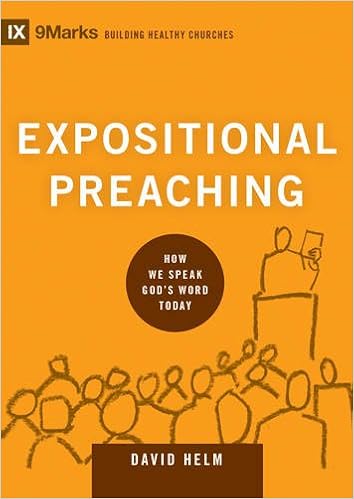 The atheist philosopher Friedrich Nietzsche wrote, “he who knows himself to be profound endeavors to be clear; he who would like to appear profound endeavors to be obscure.” Too many homileticians labor to sound profound as they seek to make their books academic. Thankfully, not David Helm. His book, Expositional Preaching: How We Speak God’s Word Today, is short, lucid and insightful. I have read many books on preaching in recent years and, I must confess, when I picked this one up I wondered if anything worthwhile could come from such a short text. I was wrong. These 112 pages are as helpful a text on preaching as I have read in some time.
David Helm is the lead pastor for Holy Trinity Church in Chicago, Illinois and the chairman of the Charles Simeon Trust, a ministry devoted to expositional preaching. He wrote the book to be the preaching entry in the series, 9Marks: Building Healthy Churches led by Mark Dever. The first mark of a healthy church is expositional preaching, and this book explains what that means in a very readable manner. You can check out more resources on their websites, www.simeontrust.org and www.9Marks.org. I recommend both ministries as excellent resources for any pastor. Read more…
WHAT’S THE BIG IDEA?
 Should the main idea of the sermon follow the main idea of the biblical passage in expository preaching? The question strikes at the heart of what we do. Text-driven preaching answers “yes” to the question. The text should drive the sermon otherwise we are in danger of using the text to support our ideas instead of submitting our ideas to the authority of the text. I agree.
However, some preachers do not agree. One preacher recently posted an article on www.preachingtoday.com entitled “The Main Point of a Passage Should not Always be the Main Point of Your Sermon.” He used 1 Corinthians 6:12-20 as his example. The main point of the passage, he wrote, was “don’t visit the prostitutes,” and that would not apply to the listeners in his congregation very well. He decided that he should not preach the main point of the passage as the main point of his sermon. Read more…
MONDAY MORNING BLUES
 Easter Sunday was great. Monday morning, not so much!
The “Monday morning blues,” sometimes labeled the “happiness hangover,” mean something different for pastors than for others. The “Sunday night blues” turn into the “Monday morning blues” for many people because they are starting their work week. A 2015 poll conducted by Monster.com found that 76% of employees called their Sunday night emotions “really bad” (Monster. com 6/2/15). Pastors suffer from a happiness hangover not because they are starting the work week, but because they ended the work week. The emotional high of Sunday gives way to the riptide of the blues on Monday morning. Read more…
PREACHING IN A “JESUS LITE” WORLD

Today’s preacher faces the twin challenges of biblical illiteracy and chronic distractability. A 2014 study showed that 40% of Christians who attend church read their Bibles once a month or less (Jared Alcantara, “Preaching Sermons: 2027 Edition, Five Challenges and Five Opportunities Facing Pastors in the Next 10 Years,” www.preachingtoday.com/state-of-preaching). Our churches are increasingly biblically illiterate, and our attentions are constantly distracted. The average American receives 54,000 words and 443 minutes of video every day on social media. Furthermore, there is a new “outrage” demanding our attention every month. The result is that churchgoers have the spiritual attention span of a minnow darting in the shallows (Matt Woodley, “Deep Preaching in a Distracted Age,” www.preachingtoday.com/state-of-preaching). Read more…
IS THE SERMON PAGAN?

Frank Viola and George Barna popularized the charge calling the sermon a “pagan” invention by the church fathers who adopted Greek rhetoric as the form of their sermons. They wrote, “the stunning reality is that today’s sermon has no root in Scripture. Rather, it was borrowed from pagan culture, nursed and adopted into the Christian faith” (Viola and Barna, Pagan Christianity? Exploring the Roots of our Christian Practices, Tyndale House, 2008, p.86). Read more…
THE BIBLE? FOR ME?
 Applying the Bible to people today is the toughest task I face in preaching. Listeners want to know what a book written so long ago has to say to them now. It is not hard for the preacher to be relevant. That is the easy part. All I have to do is preach what people want to hear. No! The hard task is showing listeners that the Bible is relevant to their lives. The challenge is connecting the text with the application so that the Bible speaks, not me! The temptation for every preacher is to mishandle the text in our desire to be relevant. Sermons mislead more often in application than information making it our most significant challenge. Read more…
A JEREMIAH MINISTRY?
 “Well, if your church doesn’t grow,” a former pastor’s wife said to Barbara Hughes, “Kent is going to feel like a failure.” Barbara had been talking with a woman whose husband had left the pastorate to sell life insurance. She knew that success in ministry is generally measured by growth in numbers. Kent and Barbara were struggling with a declining church, and Kent felt like a failure. They tell their story in Liberating Ministry from the Success Syndrome. I remember sitting in a classroom years ago listening to Kent and Barbara and thinking how helpful it was to me as a new pastor. Barbara told the woman, “I don’t know why, but you are wrong, and I’m not going to rest until I find out why!” Read more…
SERMON PREP AS SOUL PREP
 How do you stay fresh as a pastor? I have been asked that question many times over the years. As pastors, we spend much of our time preparing to preach. We carefully exegete the passage. The author’s intent, historical/cultural context and textual analysis play important roles in our exegesis. The danger is that sermon prep becomes an academic exercise – a technical skill we develop or a professional task we perform. Professional sermon creators preach shallow messages because our sermons come from shallow hearts. Preachers can substitute technical skills for spiritual depth leading to superficial sermons. How do we prep our souls to preach soul refreshing sermons? Read more…
BOOK REVIEW OF PASTORAL PREACHING
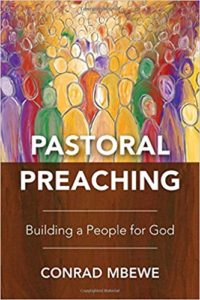
Conrad Mbewe captured my attention with his book on pastoral preaching published in 2017. I have been reflecting much on the uniqueness of pastoral preaching as distinct from evangelistic/missional and national/universal church preaching. Many leaders write books on missional preaching today. How do we reach our culture for Christ? Many of our most popular models for preaching are people who preach to the body of Christ as a whole. Their preaching is generic because their audience is general. We can gain much benefit from these resources, but I think we need more emphasis on pastoral preaching. Mbewe’s book is an excellent step in that direction, written by a local church pastor with a local church vision. Read more…